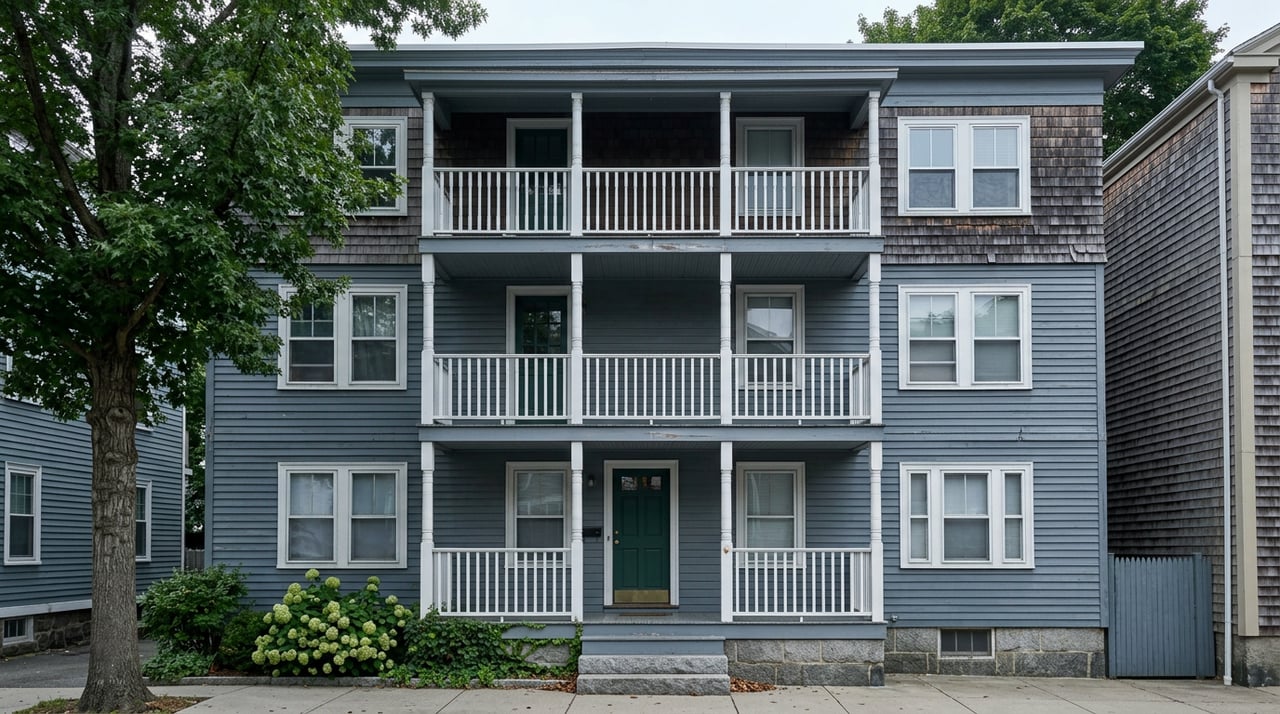
Through the first quarter of 2026, triple-decker purchase agreements in Jamaica Plain more than doubled year over year, jumping from 9 signed deals to 19. Small investors and owner-occupants are the ones absorbing that inventory, drawn by the same logic that has made the triple-decker JP's classic entry point for decades: buy the whole building, live in one unit, let the other two carry the mortgage.
At the same moment, the average asking rent across Jamaica Plain apartments actually fell. As of August 2026, it sits at $3,165, down 2.81 percent from $3,257 a year earlier, according to Yardi Matrix data compiled by RentCafe. Prices climbing while rents soften is not a footnote for anyone financing a triple-decker with an FHA loan. It sits directly on top of the one underwriting rule that decides whether a 3-unit purchase actually clears, and it is why some buyers are learning their deal does not work in the week before closing rather than the week they wrote the offer.
The Rule Nobody Mentions at the Open House
FHA loans are the reason a triple-decker with 3.5 percent down became a realistic path into Jamaica Plain homeownership. But for any 3- or 4-unit property, FHA layers on a self-sufficiency test: the adjusted market rent from every unit in the building, including the one the buyer plans to occupy, has to meet or exceed the full monthly housing payment. Duplexes are exempt from this test entirely. Triple-deckers and four-families are not.
The test does not use the rent a seller advertises or even a signed lease at face value. When a buyer has no rental history on the property, lenders typically credit around 75 percent of the appraiser's market-rent estimate, not the full figure, to leave room for vacancy and turnover. A Jamaica Plain house-hacking guide walked through a version of this math: two rental units at roughly $3,100 a month each produce about $6,200 in gross rent, but a lender applying the standard 75 percent haircut credits closer to $2,325 per unit toward qualifying income. That gap between what a listing sheet promises and what an underwriter will actually count is where triple-decker financing quietly fails.
A Market Moving Faster Than Its Rents
That gap widens as prices rise and rents stay flat, which is close to what has been happening in Jamaica Plain this year. As of this writing, 24 multi-family properties are actively listed in the neighborhood at a median price of $1.57 million. Recent closed sales back that up: a 6-bedroom, 3,781-square-foot triple-decker on Alveston Street sold for $1,835,950 in the first quarter of 2026, and a comparable building on Prince Street closed near $1.8 million the same quarter.
Run those numbers against a rent picture that dipped instead of climbed, and the self-sufficiency test gets harder to clear on exactly the properties driving the current wave of activity. A triple-decker priced at or above JP's current multi-family median needs rent support that keeps pace with that price. When average rent moves the other direction, even by a few percentage points, the math that made the deal work on a spreadsheet in January can fail an appraiser's rent schedule by summer.
This is not a reason to avoid Jamaica Plain triple-deckers. It is a reason to know which structure you are financing before you write an offer.
The Difference a Duplex Makes
The self-sufficiency test's unit-count threshold is one of the few places where a small structural choice changes the entire financing conversation:
| Units | 2026 FHA standard-area loan limit | Self-sufficiency test applies |
|---|---|---|
| 2 (duplex) | $693,050 | No |
| 3 (triple-decker) | $837,700 | Yes |
| 4 | $1,041,125 | Yes |
These are the national standard-area figures; high-cost metro areas carry higher ceilings, which matters for a market where the multi-family median already sits well north of $1.5 million. But the more useful detail for a Jamaica Plain buyer is the exemption line itself. A 2-unit purchase never faces the self-sufficiency test, no matter how the appraiser reads the rent roll. A buyer choosing between a duplex and a triple-decker at similar price points is not just choosing square footage. They are choosing whether their loan file clears one more underwriting hurdle or skips it entirely.
Where Inspections Add to the Math
Even a triple-decker that clears the self-sufficiency test still has to pass an FHA appraisal against minimum property condition standards, and Jamaica Plain's housing stock, mostly built between the 1880s and 1930s, tends to surface the same items on nearly every inspection:
- Knob-and-tube wiring or undersized electrical panels
- Porches showing rot, sagging, or loose ledger attachments
- Fire separation between units, which matters more once a building is classified for three or more dwelling units under state code
- Boilers and hot water systems nearing the end of their service life
- Pre-1978 lead paint, which triggers federal disclosure requirements regardless of financing type
- Oil tanks, including buried tanks that may not be visible during a walkthrough
None of these items are unusual for a building this age. What matters is timing. A financing file that is already tight because of the self-sufficiency test has less room to absorb a second problem discovered during inspection. A porch repair estimate or an electrical upgrade quote that shows up after the appraisal can push a marginal deal from workable to dead, especially if it changes the property's as-is value enough to affect the loan-to-value calculation.
When the Building Is Already a Condo
Some Jamaica Plain triple-deckers on the market today have already been legally converted into individual condominiums, and that changes the financing conversation completely. Buying one converted unit means financing a single residential property, not a whole three-family building, so the self-sufficiency test never enters the picture.
Converting a whole building yourself is a longer process. Massachusetts condominium law requires a recorded master deed before units can be sold individually, and Boston layers on its own Condominium and Cooperative Conversion Ordinance for buildings of four or more units built before 1983, which requires a Conversion Permit from the Inspectional Services Department, a $1,000 per-unit filing fee, and a tenant notification form submitted to the city's Department of Neighborhood Development. A buyer eyeing a whole-building triple-decker with conversion in mind should treat that timeline and fee structure as part of the purchase math, not a detail to sort out after closing.
The Move Some Buyers Are Making Instead
Buyers who run into the self-sufficiency squeeze on Sumner Hill or Pondside pricing have a couple of paths worth understanding before they walk away from Jamaica Plain altogether. Conventional financing through Fannie Mae's 2-to-4-unit guidelines applies a different underwriting framework than FHA and does not carry the same self-sufficiency test, though it typically requires a larger down payment, generally around 15 percent for an owner-occupant, and lenders still apply their own reserve and documentation standards.
The other option is geographic. Jackson Square, along the JP-Roxbury border, has been flagged as one of the few remaining pockets in the neighborhood where pricing still reflects the area's transitional status even as city and state investment continues nearby. A lower entry price relative to achievable rent is precisely the condition that makes the self-sufficiency math easier to clear, which is worth factoring in for buyers whose FHA numbers do not work on a triple-decker priced at JP's core-neighborhood median.
Frequently Asked Questions
Does the self-sufficiency test apply to every FHA loan on a Jamaica Plain multi-family? No. It applies only to 3- and 4-unit purchases. A 2-unit property financed with an FHA loan is exempt from this specific test.
What if I already have signed leases instead of an appraiser's rent estimate? Lenders generally shift to actual lease income or documented tax returns once a rental history exists, rather than relying solely on the appraiser's market-rent projection used for a property with no operating history.
Does buying a unit in an already-converted triple-decker face the same hurdle? No. Purchasing one legally converted condominium unit is financed as a single residential property. The whole-building self-sufficiency test does not apply because you are not financing the entire multi-family structure.
Financing terms, loan limits, and appraisal requirements vary by lender and by property, and buyers should confirm current numbers with their loan officer before writing an offer on a specific address.
Jamaica Plain's triple-decker market rewards buyers who understand the financing mechanics before they compete for a listing, not after. Roberta Orlandino works with house-hackers, small investors, and owner-occupants across Jamaica Plain and Boston's inner-ring neighborhoods to structure offers that account for exactly this kind of underwriting detail. Let's Connect to talk through what a specific Jamaica Plain multi-family can actually support before you're under contract.